Māyā vs. Simulation Theory: Is Reality What We Think It Is?

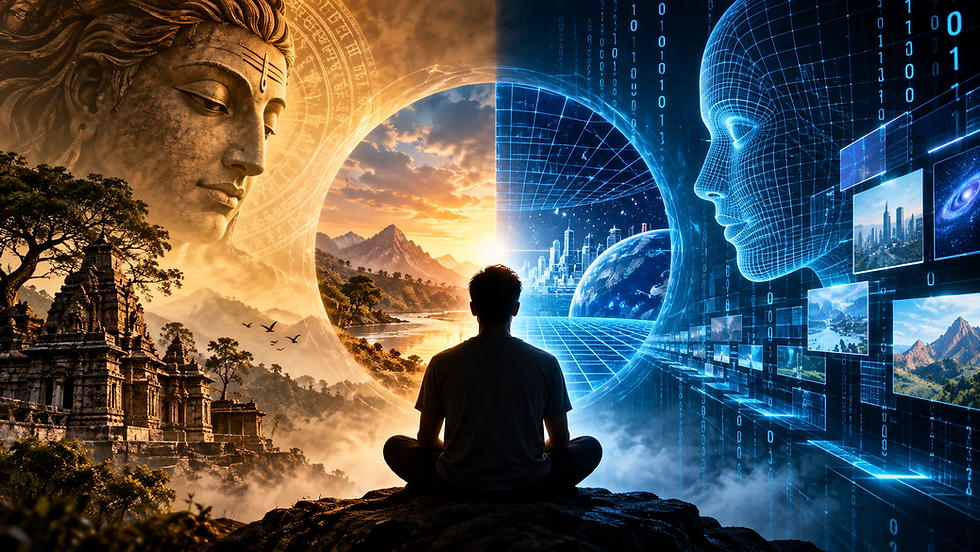
We normally begin life with an assumption so fundamental that we rarely stop to examine it: the world we experience is the world that exists. We see mountains, buildings, people and stars. We feel pleasure and pain. We experience time passing and space surrounding us. We distinguish between ourselves and everything outside us. The physical universe appears to be an objective reality into which we have been born, and our senses appear to provide us with a reasonably accurate picture of that reality.
But what if that assumption is wrong?
This question is neither new nor exclusively modern. Long before computers, virtual reality and artificial intelligence entered human thought, Indian philosophical traditions were asking profound questions about the relationship between appearance and ultimate reality. Among the concepts that have become especially famous in this context is Māyā, particularly in Advaita Vedānta. In simplified popular explanations, Māyā is sometimes described as the idea that "the world is an illusion." That description, however, is too crude to capture the philosophical complexity of the concept.
More than a millennium later, modern philosophers and technologists have arrived at a radically different but strangely familiar question: could the reality we experience be a simulation? The contemporary Simulation Hypothesis proposes that an advanced civilization might possess sufficient computational capability to create conscious simulations of beings like ourselves. If such simulations were possible and sufficiently numerous, philosopher Nick Bostrom argued in 2003 that at least one of several propositions about civilization, technological development and simulation must be true, including the possibility that we ourselves are living in a computer simulation.
At first glance, the resemblance is extraordinary.
Ancient Indian philosophy speaks about Māyā and the distinction between appearance and ultimate reality. Modern philosophy asks whether our apparently physical universe might actually be a computational construct. Both appear to challenge the assumption that what we experience is necessarily the deepest level of reality.
But is that enough to say that the ancient Indians already understood Simulation Theory?
No.
And that distinction is precisely where the subject becomes interesting.
Rather than asking whether Māyā "proves" Simulation Theory, perhaps the more valuable question is this: why do two radically different intellectual traditions, separated by centuries and developed within completely different conceptual frameworks, arrive at questions about the apparent nature of reality?
That is the question worth exploring.
What Is Māyā?
The Sanskrit term Māyā has accumulated a number of meanings across Indian philosophical and religious traditions, and treating it as a simple synonym for "illusion" can be misleading. In the Advaita Vedānta tradition associated particularly with Śaṅkara, the problem is not merely that the physical world is fake in the ordinary sense of the word.
Advaita begins from a radically non-dual conception of reality. Brahman is understood as the ultimate reality, while the apparent multiplicity of the empirical world does not possess an independent existence apart from Brahman. The individual self, or Ātman, is ultimately identified with Brahman. The appearance of separateness and plurality is associated with ignorance and erroneous cognition.
This is why the popular statement "the world is an illusion" needs considerable qualification.
If an illusion means something that simply does not exist, then the statement is inadequate. We clearly experience the world. We act within it. Actions have consequences. Hunger, pleasure, suffering, relationships, morality and physical events all operate at the level of ordinary experience.
The philosophical question is therefore deeper.
The issue is not simply whether the world exists. It is what kind of reality it possesses.
Advaita uses the concept of mithyā in discussing the empirical world: the world is neither absolutely real in the sense of possessing independent ultimate existence nor simply nonexistent. It is experienced, but its apparent independent status is mistaken. The ultimate reality underlying existence is Brahman. The distinction between appearance and ultimate reality is therefore central to the philosophical problem.
This makes Māyā fundamentally different from the popular idea of a magician creating a fake world.
The problem is epistemological as much as metaphysical: we mistake what appears for what ultimately is.
The Rope and the Snake
One of the most useful ways of understanding the Advaita approach is through the traditional example of mistaking a rope for a snake.
Imagine walking through a dimly lit environment and seeing what appears to be a snake. You experience fear. Your body reacts. You may even run away.
But when sufficient light appears, you discover that there was never a snake there. There was a rope.
The experience of the snake was real as an experience. Your fear was real. Your perception occurred. Yet the object you believed you were perceiving was misunderstood.
The crucial point is therefore not simply that the snake was "fake."
The problem was misidentification.
The rope existed, but ignorance caused the mind to interpret it incorrectly.
This analogy provides a useful philosophical bridge to the question of reality. Advaita's concern is that ordinary human beings may similarly mistake the phenomenal world, individuality and separateness for ultimate reality. Śaṅkara's philosophy places knowledge at the centre of liberation because ignorance is understood as the source of the mistaken perception of separateness.
And this is where the comparison with Simulation Theory becomes tempting.
Enter the Simulation Hypothesis
The modern Simulation Hypothesis comes from an entirely different intellectual background.
In 2003, philosopher Nick Bostrom published his influential paper Are You Living in a Computer Simulation? Bostrom did not simply claim that we are living inside a computer. Instead, he constructed a philosophical argument involving the future development of civilizations and their potential ability to create enormous numbers of simulations containing conscious observers.
His argument can be summarized through three possibilities. Either civilizations such as ours almost always become extinct before reaching a technologically mature "posthuman" stage; or sufficiently advanced civilizations rarely choose to create large numbers of ancestor simulations; or, if advanced civilizations do create enormous numbers of such simulations, statistically speaking we could be more likely to be among the simulated observers than among the original biological beings. Bostrom concluded that at least one of those propositions must be true.
This is important because the Simulation Hypothesis is often presented incorrectly as though Bostrom scientifically demonstrated that we live inside a computer.
He did not.
The simulation argument is a philosophical argument based on assumptions about future technological civilizations, computational capacity and the nature of conscious simulations. It does not constitute experimental evidence that our universe is actually a computer simulation.
That distinction matters.
A hypothesis about what reality might be is not the same thing as evidence demonstrating what reality is.
The First Great Similarity: Appearance Is Not Necessarily Ultimate Reality
Despite their differences, Māyā and Simulation Theory touch the same unsettling philosophical nerve.
Our everyday experience may not reveal the ultimate nature of reality.
For the simulation hypothesis, the physical universe we experience could theoretically be generated by an underlying computational system. What appears to us as matter, space and time could be features of a simulated environment.
For Advaita Vedānta, the empirical world does not possess independent ultimate existence apart from Brahman. What we experience as a universe of separate objects and individual selves is conditioned by ignorance and mistaken identification.
In both cases, therefore, appearance does not automatically equal ultimate reality.
This is perhaps the strongest legitimate comparison between the two.
But even here, caution is necessary.
Simulation Theory says that the apparent physical world might be generated by another physical or computational level of reality.
Advaita asks a much more radical question: what is the nature of reality itself, and what is the status of consciousness that knows it?
The two questions overlap, but they are not identical.
The Simulation Is Not the Same as Māyā
Imagine, for a moment, that humanity discovers overwhelming evidence that the universe is indeed a computer simulation.
We would then naturally ask: who created it?
Perhaps an advanced civilization did. Perhaps there is some unimaginably sophisticated computational substrate outside our observable universe. Perhaps simulated beings themselves eventually create further simulations.
But notice what has happened.
We have not escaped the problem of reality.
We have simply moved it one level higher.
If our universe is a simulation running on a computer, then the computer exists in some larger reality. What is that reality? If that reality is itself simulated, then what lies beyond it? And if every level is simulated, where does the chain ultimately terminate?
Simulation Theory therefore does not automatically answer the question of ultimate reality. It potentially relocates it.
Advaita approaches the problem differently.
The ultimate reality in Advaita is Brahman. Brahman is not simply another physical environment outside our universe, nor is Brahman necessarily equivalent to a cosmic computer. The metaphysical framework is non-dual: ultimate reality is not one object among many objects. Advaita identifies Brahman with the fundamental reality underlying the plurality of experience and connects the deepest understanding of the self, Ātman, with Brahman.
That makes the comparison much more subtle than the familiar statement:
"Māyā means we are living in a simulation."
It does not.
A Programmer Is Not Necessarily Brahman
The idea of a programmer is one of the most obvious differences.
A computer simulation normally implies a distinction between the simulator and the simulated environment. There is a system that runs the simulation and a simulated world that exists within it.
This gives us a conceptual structure:
Programmer → Computer → Simulation → Simulated observers
Advaita does not fit comfortably into that structure.
Brahman is not simply a programmer sitting outside the universe in the way a human programmer sits outside a computer game. The relationship between Brahman and the world is much more philosophically complex. In Advaita, the world is dependent upon Brahman and does not possess an independent existence apart from it. Brahman is the fundamental reality rather than merely an external engineer who happens to construct the universe.
The difference is fundamental.
A programmer is normally an entity within or associated with a larger framework of existence.
Brahman, in Advaita, is intended to be the ultimate reality itself.
Therefore, equating Brahman with a hypothetical programmer may actually obscure rather than clarify the philosophy.
The More Interesting Question: What Is the Observer?
Perhaps the most fascinating point of contact between these ideas is not the universe but consciousness.
Suppose we really were living inside an advanced simulation.
What would that mean for us?
Would our consciousness itself be simulated? Would there be a biological brain outside the simulation corresponding to every simulated mind? Could consciousness emerge entirely within computation? Could a sufficiently advanced simulation contain genuinely conscious beings?
These are unresolved philosophical questions.
And they lead directly to one of the deepest issues in the comparison with Advaita.
Advaita does not begin by asking whether consciousness is a product of a sufficiently advanced computer. It places consciousness much closer to the centre of its metaphysics. Classical Advaita understands Ātman as pure consciousness and identifies it ultimately with Brahman.
This reverses the direction of the modern technological question.
Modern simulation thinking often begins with a physical universe and asks whether consciousness could arise within a sufficiently sophisticated computational system.
Advaita begins with consciousness as fundamental and asks how the apparent world of multiplicity is understood in relation to it.
These are profoundly different starting points.
Could Consciousness Exist Inside a Simulation?
This is where Simulation Theory becomes more philosophical than technological.
A simulation can reproduce information. It can reproduce physical processes. It can model human behaviour. But does a sufficiently complex simulation necessarily produce subjective experience?
If a simulated human says, "I am conscious," is there actually someone experiencing that consciousness inside the simulation?
This is the famous philosophical problem of subjective experience.
We know that we are conscious because we experience consciousness directly. But we do not possess an external instrument that can simply look at another entity and measure its subjective experience in the same way that we measure temperature or mass.
If consciousness is computational, then a sufficiently advanced simulation might contain genuinely conscious beings.
If consciousness is not reducible to computation, then merely simulating a brain might not be enough.
The Simulation Hypothesis therefore depends, at least in some formulations, on assumptions about consciousness that remain philosophically contested.
Advaita approaches consciousness from a radically different direction. Consciousness is not merely another phenomenon generated by the universe. In classical Advaita, consciousness is fundamental to the nature of Ātman and Brahman.
This creates a remarkable philosophical inversion.
Perhaps the deepest question is not:
"Is the universe simulated?"
but:
"What is the nature of the consciousness that experiences the universe?"
Ancient Philosophy Did Not Predict the Computer
This is where intellectual discipline becomes essential.
It is tempting to look at a sophisticated ancient philosophical concept and reinterpret it through modern technological language. Because we now live in a world of virtual reality, artificial intelligence, computer graphics and digital simulations, concepts such as Māyā can appear remarkably familiar.
But similarity does not establish historical prediction.
There is no reason to claim that the ancient Indian philosophers were secretly describing computer programs, digital processors or virtual reality systems.
They were addressing metaphysical and epistemological questions within their own intellectual traditions.
Advaita Vedānta emerged from engagement with the Upaniṣadic tradition and developed a sophisticated account of Brahman, Ātman, knowledge, ignorance and the empirical world. Śaṅkara's philosophy belongs to a radically non-dual metaphysical framework that cannot simply be translated into the language of modern computing.
Likewise, modern Simulation Theory belongs to a technological and philosophical context involving computational power, artificial intelligence and hypothetical future civilizations.
The resemblance is therefore best understood as a philosophical parallel, not a historical prediction.
And perhaps that makes the comparison more interesting, not less.
Why Do They Meet at All?
Why should two traditions separated by such an enormous historical and conceptual distance arrive at questions that seem to overlap?
One possibility is that certain philosophical problems are unavoidable once human beings begin questioning the reliability and completeness of ordinary perception.
Our senses provide us with a model of reality, but they do not necessarily provide us with reality in its entirety.
Modern physics has already shown that the universe behaves in ways radically different from ordinary human intuition. Space and time are not as absolute as everyday experience suggests. Matter at fundamental scales does not behave like the solid objects we encounter in everyday life.
None of this proves Māyā.
None of it proves Simulation Theory.
But it does demonstrate something important: human intuition is not necessarily an infallible guide to the deepest structure of reality.
Indian philosophical traditions explored this problem through concepts such as ignorance, perception, consciousness and ultimate reality. Modern science approaches it through mathematical models, experimentation and physical theory.
The methods are different.
The questions can sometimes intersect.
Māyā Is Not Simply "The World Is Fake"
One of the greatest dangers in popular discussions of this subject is the tendency to turn sophisticated philosophical concepts into catchy slogans.
"Māyā means everything is an illusion."
"Ancient India knew we live in a simulation."
"Quantum physics proves the universe is Māyā."
All three statements go far beyond what the underlying evidence and philosophical traditions justify.
Māyā should not be reduced to the claim that the physical universe does not exist.
In Advaita, the empirical world has a dependent and experienced reality, while Brahman is ultimate. The problem is our mistaken understanding of the world as possessing independent and ultimate existence. The tradition is therefore concerned with knowledge and liberation, not merely with announcing that physical reality is fake.
This distinction is crucial.
A person who realizes that a virtual reality game is a simulation has discovered something about the game's underlying technology.
A person who, in the Advaita framework, realizes the nature of Brahman has undergone something much more profound: a transformation in the understanding of self and reality.
These are not equivalent achievements.
There Is Another Important Difference: The Goal
Simulation Theory and Advaita Vedānta also differ dramatically in their purpose.
Simulation Theory is primarily an argument about the possible nature of reality. Even if someone became convinced that the universe is simulated, that discovery would not automatically tell them how to live, how to overcome suffering or how to achieve liberation.
Advaita is not merely a theory about the universe.
It is also a path of knowledge.
The question of reality is connected to the question of human bondage and liberation. If ignorance causes us to mistake the limited individual self for our ultimate identity, then knowledge of Brahman becomes transformative. The purpose is not simply to win an argument about metaphysics but to overcome ignorance and attain mokṣa.
This difference should prevent us from treating Māyā as a primitive form of Simulation Theory.
They may resemble each other at one level while operating at completely different levels at another.
What If the Universe Really Is a Simulation?
Let us nevertheless take the modern hypothesis seriously for a moment.
Suppose future evidence somehow demonstrated that our universe is a simulation.
Would that make ancient Indian philosophy correct?
Not automatically.
It would demonstrate something about the physical structure or origin of our observable reality. It would not, by itself, establish the existence of Brahman, the identity of Ātman and Brahman, or the Advaita account of liberation.
Conversely, suppose philosophical inquiry eventually demonstrated that the Advaita conception of ultimate reality was correct.
Would that prove that the universe is running on a computer?
Again, no.
The two propositions belong to different explanatory frameworks.
One concerns a hypothetical computational substrate.
The other concerns the metaphysical nature of reality and consciousness.
The temptation to make them identical is precisely what we should resist.
Perhaps the Real Parallel Is More Profound
There may nevertheless be a deeper connection.
Both approaches challenge naïve realism—the assumption that the world as immediately experienced must be identical to reality at its deepest level.
Simulation Theory says:
What appears to be physical reality might arise from an underlying computational reality.
Advaita says, in a very different philosophical framework:
What appears as a world of separate entities does not possess independent ultimate reality apart from Brahman.
The first introduces the possibility of another physical or computational layer.
The second questions the very framework through which we divide reality into separate entities.
One asks whether reality is generated.
The other asks what reality is.
That distinction is easy to miss, but it may be the most important insight in the entire comparison.
From "Are We Simulated?" to "What Is Real?"
The popular version of Simulation Theory is exciting because it sounds like science fiction.
Perhaps there is a vast computer somewhere.
Perhaps our universe is an artificial construct.
Perhaps beings outside our universe created us.
Perhaps there are billions of simulated worlds.
But once we move beyond the science-fiction imagery, the philosophical question becomes much larger.
What qualifies something as real?
Does something have to be physically fundamental to be real?
If a conscious being exists inside a simulation and experiences love, suffering, memory and hope, are those experiences less real because their environment is computational?
If our universe has an underlying substrate, does that make our experiences meaningless?
And if there is an ultimate reality beyond the world of appearances, how could human beings know it?
These questions take us remarkably close to the concerns of Indian philosophy.
But they also take us beyond the Simulation Hypothesis itself.
The Observer at the Centre
Perhaps this is where the ancient and modern questions finally meet.
We normally imagine reality as something "out there" and ourselves as observers looking at it.
But consciousness introduces a strange complication.
Everything we know about the universe is mediated through experience.
We do not experience "reality itself" in some completely unfiltered manner. We experience perceptions, thoughts, sensations and interpretations. Our brains construct models of the world from sensory information. Modern neuroscience studies this process scientifically; Indian philosophical traditions explored perception and cognition through their own sophisticated epistemological systems. Classical Indian philosophy contains extensive debates about how perception and cognition relate to reality, including within Advaita Vedānta.
So perhaps the most interesting question is not whether there is a computer somewhere running our universe.
Perhaps it is:
How much of the reality we experience is reality itself, and how much is the model constructed by the observer?
That question is much older than computers.
And it remains unresolved.
Two Traditions, One Question?
Māyā and Simulation Theory should therefore not be treated as two names for the same idea.
They are not.
Māyā belongs to a broad and complex family of Indian philosophical discussions, and its meaning cannot be reduced to "computer simulation." Advaita Vedānta's metaphysics of Brahman, Ātman, ignorance and liberation is fundamentally different from a technological hypothesis about simulated universes.
Simulation Theory, meanwhile, is a modern philosophical argument built around assumptions about technological civilization, computational resources and the possibility of simulated conscious observers.
Yet the comparison remains worthwhile because both challenge an assumption that human beings often make without noticing it:
that the reality we experience is necessarily the ultimate reality.
That is a surprisingly powerful point of convergence.
The Question We Should Leave Open
Perhaps the greatest mistake would be to conclude this discussion with a confident declaration.
We do not know that the universe is a simulation.
We do not possess scientific evidence establishing that Māyā describes a computational universe.
And modern science has not demonstrated that consciousness is either fundamentally computational or fundamentally non-computational.
What we do have are questions.
Ancient Indian philosophers asked whether the world of ordinary experience represents ultimate reality.
Modern philosophers ask whether our physical universe could be an artificial computational environment.
Science investigates the structure of the observable universe.
Philosophy asks what it means for something to be real.
And consciousness continues to sit strangely at the centre of all three investigations.
Perhaps the most intriguing possibility is not that ancient India secretly discovered computers.
Perhaps it is that human beings, separated by thousands of years and radically different intellectual environments, repeatedly encounter the same profound difficulty:
we experience reality, but we may never be completely certain that we understand what reality ultimately is.
Māyā does not prove Simulation Theory.
Simulation Theory does not prove Māyā.
But placed beside each other, they invite us to look once again at the assumption we normally take for granted.
What if reality is not quite what it appears to be?
And perhaps an even more difficult question follows:
If our perception of reality is limited, who—or what—is the observer trying to understand it?
That question may be harder than the simulation itself.


Comments