The Mystery of Zero: How Ancient India Changed Mathematics Forever

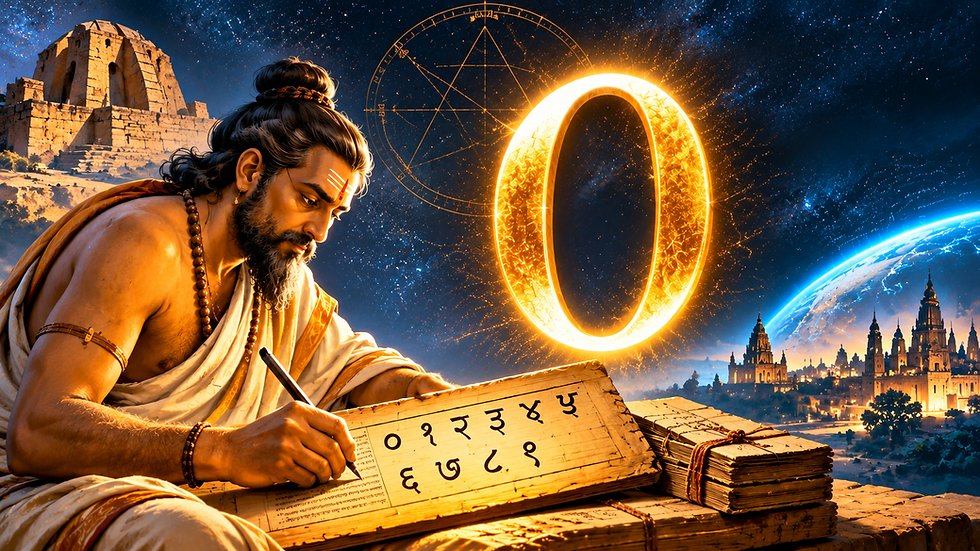
What is zero? At first glance, the answer appears remarkably simple. It represents nothing, an absence of quantity, or the absence of something that might otherwise have been counted. Yet this apparently insignificant symbol is among the most consequential intellectual developments in human history. Modern mathematics, scientific calculations, computer technology and countless aspects of contemporary civilisation depend upon the mathematical framework in which zero plays an indispensable role.
But zero was not always understood in the way we understand it today. For thousands of years, human beings developed systems to count, measure and represent quantities. They could describe what existed, calculate what they possessed and record what they exchanged. However, representing the absence of a quantity presented a different intellectual challenge. Even more remarkable was the eventual recognition that nothing could itself become an object of mathematical calculation.
One of the most important chapters in this extraordinary journey unfolded in ancient India. Indian mathematicians made foundational contributions to the development of zero within a positional decimal number system and to its treatment as a mathematical concept. Their work eventually became part of a numerical tradition that transformed the intellectual foundations of the world.
Before Zero: How Ancient Civilisations Represented Numbers
The history of mathematics began long before the appearance of the modern numerical system. Ancient civilisations developed different methods of recording quantities, often using symbols, inscriptions and combinations of numerical signs.
The Egyptians employed a system of hieroglyphic numerals, while the Romans developed a system using letters such as I, V, X, L and C. These systems were useful for recording quantities, conducting trade and administering increasingly complex societies. However, they did not possess the same flexibility as the positional decimal system used today.
The Babylonians developed a sophisticated sexagesimal, or base-sixty, positional number system. They eventually employed a special sign to indicate an empty position within a number. This was an important development because it helped distinguish numerical positions. However, the Babylonian placeholder was not yet equivalent to the fully developed mathematical concept of zero.
The ancient Maya independently developed a sophisticated numerical system that included a symbol for zero. Their mathematical achievements demonstrate that different civilisations independently explored the problem of representing absence.
These developments are important because they remind us that the history of zero was not the achievement of a single individual or civilisation in isolation. It was a long intellectual process involving different mathematical traditions. Nevertheless, the Indian contribution would prove particularly transformative because of the integration of zero into a powerful decimal place-value system and the development of mathematical rules governing its use.
India's Mathematical Revolution: The Power of Place Value
To understand the significance of ancient Indian mathematics, consider the difference between the numbers 1, 10, 100 and 1,000. The digit remains the same, but its value changes according to its position. This is the fundamental principle of a positional number system.
In a decimal system, each position represents a power of ten. The rightmost position represents units, the next represents tens, followed by hundreds, thousands and so on. Zero makes this arrangement possible.
Consider the number 105. The zero indicates that there are no tens between the one hundred and the five units. This apparently simple function makes numerical representation extraordinarily efficient.
The Indian decimal place-value system provided a remarkably flexible method of expressing large numbers using only ten symbols. Instead of requiring separate symbols for different quantities, the same digits could be combined according to their positions. This was not merely a convenient improvement in writing numbers. It transformed the possibilities of arithmetic.
Calculations involving multiplication, division, addition and subtraction became more systematic. Large quantities could be represented compactly, and increasingly complex mathematical operations could be performed with greater efficiency. Indian mathematicians also began exploring the properties of zero and its relationship with other numbers. That transition represented a major intellectual achievement.
Brahmagupta: Giving Zero a Mathematical Identity
Among the most important figures in this development was Brahmagupta, the celebrated Indian mathematician and astronomer who lived during the seventh century CE. Working in the intellectual environment of Ujjain, an important centre of astronomical and mathematical learning, Brahmagupta produced one of the most influential works in the history of Indian mathematics.
In 628 CE, he composed the Brahmasphutasiddhanta, a comprehensive astronomical and mathematical treatise. One of its most significant contributions was the systematic treatment of zero and its relationship with positive and negative numbers.
Brahmagupta described zero as the result of subtracting a number from itself. In modern mathematical notation, this can be expressed as a − a = 0. He also formulated rules governing arithmetic operations involving zero and positive and negative quantities.
His work demonstrated that zero was no longer merely a convenient symbol occupying an empty position. It had become an object of mathematical reasoning.
There were, of course, limitations in his treatment. Some of the rules concerning division by zero did not correspond to the mathematical understanding established in later centuries. Modern mathematics recognises that division by zero is undefined in ordinary arithmetic.
Nevertheless, Brahmagupta's contribution was historically significant. He helped establish a systematic mathematical framework for working with zero, taking an important step towards the number system that would eventually become universal. His achievement illustrates the intellectual sophistication of mathematical inquiry in ancient India.
From India to the World: The Journey of the Indian Numerals
An important mathematical discovery becomes truly transformative when its usefulness extends beyond the civilisation in which it develops. The Indian numerical system gradually travelled beyond the subcontinent through trade, scholarship, cultural interaction and intellectual exchange.
The Arab world played a particularly important role in transmitting and further developing Indian mathematical knowledge. Scholars writing in Arabic studied Indian numerical methods and recognised the extraordinary advantages of the positional decimal system.
One particularly important figure was Al-Khwarizmi, the ninth-century Persian mathematician whose writings on Indian calculation contributed significantly to the spread of these methods.
The Indian numerical system eventually reached Europe through multiple channels, including translations and scholarly exchanges. European mathematicians and merchants gradually adopted the system, recognising its advantages over older numerical methods.
The transition was not immediate. Roman numerals continued to be used for centuries, and the adoption of the new system encountered resistance in certain commercial and intellectual environments. Nevertheless, the advantages of the positional decimal system were undeniable.
The numerical symbols and methods that eventually became known as Hindu-Arabic numerals transformed accounting, commerce, astronomy, mathematics and scientific investigation. The name itself recognises an important historical reality: the numerical tradition had Indian origins and was transmitted and developed through Arabic scholarship before becoming widely established in Europe.
Zero and the Foundations of Modern Technology
The significance of zero becomes even more remarkable when we consider the technological world in which we live. Modern computers operate using binary systems, which represent information through combinations of two digits: zero and one.
These digits form the foundation of digital information processing. Computers use binary representations to perform calculations, store information, process images, transmit communications and execute complex instructions.
The role of zero extends far beyond computing. It is indispensable in algebra, calculus, physics, engineering, astronomy, economics and countless other disciplines. Modern scientific instruments, satellites, financial networks and digital communication systems depend upon mathematical frameworks in which zero is fundamental.
This does not mean that ancient Indian mathematicians anticipated modern computers. Rather, the numerical foundations to which they contributed became part of the broader intellectual heritage upon which later mathematical and technological developments were built. It is a remarkable illustration of how an abstract mathematical idea can acquire consequences far beyond the imagination of those who first explored it.
The Deeper Significance: When Nothing Became Something
Perhaps the greatest achievement associated with zero is not the symbol itself, but the transformation in mathematical thinking that it represents. Human beings had always understood the difference between possessing something and possessing nothing. Yet expressing that absence within a consistent numerical framework required a different level of abstraction.
Zero allowed mathematicians to represent absence within a system of quantities. It provided a placeholder in positional notation and eventually acquired an identity within mathematical operations. This development expanded the boundaries of numerical reasoning.
It also offers a fascinating philosophical reflection. Nothingness, which appears to represent the absence of everything, became an indispensable component of a system used to describe the world.
The journey of zero reminds us that some of humanity's greatest intellectual achievements do not emerge from discovering something physically visible. They emerge from developing new ways of thinking about abstract concepts. Ancient Indian mathematics contributed significantly to this transformation.
Conclusion: The Number That Changed Everything
Today, zero is so familiar that its historical significance is easy to overlook. Children learn it alongside other numbers, calculators display it effortlessly, and computers process it billions of times. Yet behind this simple symbol lies a remarkable intellectual journey involving ancient civilisations, mathematical experimentation and centuries of scholarly exchange.
India occupies a particularly important place in this history. Its mathematicians helped develop the decimal place-value system and advanced the mathematical treatment of zero, creating foundations that would eventually travel across continents.
The story of zero is therefore not simply the history of a number. It is the story of how human thought evolved, how knowledge travelled between civilisations and how an abstract idea could transform the course of technological development.
A symbol representing nothing became indispensable to almost everything. And perhaps that is the greatest mystery of zero.
Indic Eternum – Exploring the ideas, knowledge and intellectual traditions that shaped human civilisation.


Comments