Ātman and Energy: The Ancient Indian Theory of Consciousness and Reality


What if consciousness is not merely something produced by the human brain? This question lies at the heart of one of the oldest philosophical inquiries in human civilisation. Modern science has made extraordinary progress in understanding the physical universe. We can observe distant galaxies, examine the structure of atoms, map the human brain, measure electrical activity within neurons and describe many of the biological mechanisms associated with perception, memory and thought. Yet one fundamental mystery remains remarkably resistant to complete explanation: why does physical activity give rise to subjective experience? We can describe what happens when light enters the eye and signals travel through the nervous system, but why does that process result in the actual experience of seeing? We can identify neurological processes associated with pain, but why does pain have an internal quality that is experienced by someone? We can study the brain in increasingly sophisticated ways, but the existence of the subjective self remains one of the deepest questions in philosophy and science.
Long before modern neuroscience, Indian philosophical traditions were asking this question from a fundamentally different direction. Instead of beginning with matter and attempting to explain how consciousness might emerge from it, the ancient Indian philosophical tradition frequently began with consciousness itself. The question was not simply what the world is made of, but who is experiencing the world. Who am I beneath my changing body, thoughts, memories and emotions? Is the individual merely a temporary biological organism, or is there a deeper principle of self that exists beyond the constantly changing physical and psychological personality? It was within this profound inquiry that the concept of Ātman emerged as one of the central ideas of Upanishadic and Vedantic thought.
The modern temptation is to immediately describe Ātman as “energy.” This is understandable because contemporary language often uses energy as a broad term for invisible forces or forms of existence. However, such an equation would be philosophically and scientifically inaccurate. Ātman is not simply a form of physical energy as defined by modern physics, and there is no established scientific evidence demonstrating that consciousness is a measurable energy field corresponding to the ancient concept of Ātman. Yet this does not make the comparison meaningless. On the contrary, it opens a much more interesting conversation. The real question is whether ancient Indian philosophy was investigating a dimension of reality that cannot be reduced simply to matter, energy or the physical mechanisms of the brain. To explore that possibility, we must first understand what the ancient thinkers actually meant by Ātman.
The Question: Who Am I?
The inquiry into Ātman begins with a deceptively simple question: Who am I? At first glance, the answer seems obvious. I am my body. I have a particular face, height, biological structure and physical identity. But the body changes continuously throughout life. The body of a child is not the body of an adult, and the body of an adult is not the body of an elderly person. Cells are replaced, physical characteristics change and the entire organism undergoes continuous transformation. Yet despite these changes, there remains a powerful sense of continuity. We remember our childhood and say, “That was me.” We look at an old photograph and recognise ourselves even though the physical person in the photograph may look dramatically different from the person looking at it today. Something appears to connect the different stages of our existence.
Perhaps, then, the answer is the mind. But the mind also changes. Thoughts arise and disappear. Emotions fluctuate. Beliefs change. Memories can become distorted or disappear. Personality develops throughout life. The person we were twenty years ago may have very different ambitions, fears, opinions and emotional responses from the person we are today. Yet again there is a sense that the changing mind belongs to an underlying “I.” We say, “I had that thought,” “I experienced that emotion,” or “I remember that event.” The thought changes, but the one who recognises the thought appears to remain.
This leads to a deeper philosophical distinction. I can observe my body. I can feel its sensations. I can observe my thoughts. I can recognise my emotions. I can remember experiences from the past. But what is the principle through which all of these are known? If the body is something I can observe, and the mind is something I can observe, then the ancient Indian philosophical inquiry asks whether there is something deeper than both the body and the mind—the fundamental subject that experiences them. This is where Ātman enters the discussion. Ātman is not simply another object hidden somewhere inside the body. It represents the deepest dimension of self, the principle of identity and consciousness that lies beneath the changing characteristics of the individual.
Ātman Is More Than the Ordinary Self
The word Ātman is often translated into English as “self,” “soul” or “inner self,” but each translation has limitations. In ordinary conversation, when we speak about ourselves, we usually mean the personality associated with our name, memories, body, relationships and individual history. Indian philosophical traditions often distinguish this everyday identity from the deeper self being investigated by the Upanishads. The ego, personality and individual identity belong to the changing field of human experience, whereas Ātman points toward what is regarded as the deepest principle of the experiencer.
This distinction becomes particularly important in Vedantic philosophy. The individual ego, often associated with ahaṃkāra, creates the sense of “I am this particular person.” It identifies itself with the body, mind, possessions, memories and social identity. But the philosophical inquiry asks whether this identification represents the ultimate nature of the self. If the body changes, the mind changes, emotions change and circumstances change, then perhaps the deepest self cannot simply be identical with any one of these temporary conditions. The question therefore becomes not merely “What am I?” but “What remains when everything that constantly changes is recognised as changing?”
This is one of the most profound features of Indian philosophical thought. Rather than defining the self immediately, the inquiry proceeds by examining what the self cannot ultimately be. I am not merely the body because the body changes. I am not merely my thoughts because thoughts change. I am not merely my emotions because emotions change. I am not merely my memories because memories can disappear. The inquiry progressively moves toward the possibility of a deeper witnessing consciousness that is not itself identical with the changing contents of experience.
In this context, Ātman is not best understood as an invisible object or a tiny spiritual entity hidden inside the heart or brain. It is better understood as a philosophical principle concerning the deepest nature of the self. In Advaita Vedanta, this inquiry ultimately leads to one of the most radical propositions in Indian philosophy: the deepest self, Ātman, is not fundamentally separate from Brahman, the ultimate reality. The famous Upanishadic statements “Tat Tvam Asi”, generally translated as “That Thou Art,” and “Aham Brahmāsmi,” generally translated as “I am Brahman,” express this profound relationship between the individual self and ultimate reality within their respective philosophical contexts.
Ātman and Prāṇa: Two Different Concepts
Any serious discussion of Ātman and energy must distinguish Ātman from Prāṇa. The two concepts are sometimes mixed together in modern popular discussions, but they have different philosophical functions. Prāṇa is traditionally associated with life, breath and vital activity. In yogic and related Indian traditions, Prāṇa is described as the vital principle associated with the functioning of the living organism, and traditional systems discuss different manifestations or movements of Prāṇa within the body. Because of this, Prāṇa is sometimes translated loosely as “life force” or “vital energy.”
However, Prāṇa should not automatically be equated with energy as defined by modern physics. Nor should Ātman be equated with Prāṇa. The distinction is important because the philosophical question concerning Ātman goes beyond biological life. Prāṇa concerns the vital processes associated with living existence, whereas Ātman concerns the deepest nature of the self and consciousness. This distinction also helps us avoid one of the most common errors in modern discussions of ancient Indian philosophy: taking a sophisticated philosophical vocabulary developed within a particular metaphysical framework and simply replacing its terms with modern scientific words.
Ancient Indian thinkers did not necessarily use the word Prāṇa in the same conceptual framework in which a modern physicist uses the word energy. Similarly, Ātman was not a scientific term waiting to be decoded using modern laboratory instruments. The intellectual achievement of these traditions lies elsewhere. They developed a systematic way of investigating life, consciousness, identity and reality using philosophical reasoning, contemplation and introspection. Their questions remain relevant even when their terminology cannot be directly translated into the vocabulary of modern science.
What Does Modern Science Mean by Energy?
The word “energy” is used extremely broadly in everyday language, but physics uses it in a much more precise manner. Energy is a measurable physical quantity associated with the capacity of a system to perform work or undergo transformation. It appears in different forms and can be transferred between physical systems. The relationship between matter and energy revealed by modern physics is one of the most important discoveries in the history of science, but it does not mean that everything that cannot currently be explained should automatically be called energy.
This distinction is particularly important when discussing consciousness. There is currently no established scientific basis for claiming that Ātman is a measurable form of physical energy. The conservation of energy does not demonstrate that individual consciousness survives bodily death, and the famous relationship between mass and energy does not establish a spiritual theory of the self. These are philosophical or metaphysical propositions rather than conclusions demonstrated by modern physics.
At the same time, the scientific definition of energy does not make the philosophical concept of Ātman irrelevant. It simply means that we should not confuse two different categories of inquiry. Physics investigates measurable physical phenomena through mathematical models and empirical observation. Indian philosophical traditions investigated questions concerning the nature of self, consciousness and ultimate reality through philosophical analysis and contemplative inquiry. The two approaches can be compared, but they should not be artificially merged.
The more interesting question is therefore not whether ancient Indian philosophers somehow discovered the modern scientific theory of energy thousands of years ago. There is insufficient evidence for such a claim, and making it would weaken rather than strengthen the intellectual value of the tradition. The more meaningful question is whether the ancient Indian investigation of consciousness can contribute something to the modern philosophical debate about what reality ultimately consists of.
The Mystery of Consciousness
This is where the discussion becomes especially relevant to the modern world. Neuroscience has demonstrated an intimate relationship between the brain and conscious experience. Damage to particular regions of the brain can affect memory, perception, personality and awareness. Anaesthesia can suppress conscious experience. Neurological disorders can alter the way individuals perceive themselves and their surroundings. These findings demonstrate that the physical condition of the brain is deeply connected with the nature of conscious experience.
But correlation does not automatically answer the deeper philosophical question of consciousness. We can describe the neural mechanisms associated with an experience without necessarily explaining why the experience exists at all. We can describe the electrical and chemical activity associated with seeing a particular colour, but the description of the neural process is not identical to the subjective experience of seeing that colour. We can map the neurological activity associated with pain, but the map does not itself explain why pain has an internal, first-person quality.
This is part of what philosophers of mind refer to as the hard problem of consciousness. The problem is not merely how the brain processes information. It is why physical information processing is accompanied by subjective awareness. Why is there something it feels like to be a human being? Why is the universe not simply a collection of physical processes occurring without anyone experiencing them?
Indian philosophical thought approached this mystery from an unusual direction. Instead of asking only how consciousness could emerge from matter, it asked whether consciousness might be more fundamental than our ordinary understanding of matter suggests. This does not prove that consciousness is fundamental, but it demonstrates that the question itself is not new. The ancient Indian philosophers were already questioning whether the experiencer could be reduced to the objects of experience.
The Observer and the Observed
Consider a simple experience. You look at a tree. From a scientific perspective, light reflected from the tree enters your eyes, the retina converts the information into neural signals, and those signals are processed through complex networks within the brain. Modern science can investigate each of these stages with remarkable precision. Yet there remains a philosophical distinction between the physical process and the experience of seeing.
The tree is observed. The sensory signals are processed. The brain performs an enormous amount of work. But the experience is still experienced by someone. Indian philosophical traditions repeatedly examined this relationship between the knower and the known, between the subject and the object, between the observer and the observed.
The body is known through sensation. Thoughts are known through awareness. Emotions are known through experience. Memories are known when they arise in consciousness. The philosophical question therefore becomes: what is the nature of the knower?
This does not necessarily mean that there is a little person sitting inside the brain watching a biological screen. Such an interpretation would merely relocate the problem. The deeper question is whether consciousness itself should be considered fundamentally different from the objects that appear within consciousness. In this sense, Ātman represents not another object of experience but the philosophical investigation of the subject itself.
The Changing Body and the Unchanging Self
One of the most powerful ways to approach the concept of Ātman is through the distinction between what changes and what appears to provide continuity. Human existence is characterised by constant transformation. The body changes from childhood to adulthood and eventually to old age. Thoughts change from moment to moment. Emotions rise and fall. Relationships change. Circumstances change. Knowledge changes. Even our understanding of ourselves changes.
Yet throughout these transformations we retain a sense of continuity. We recognise ourselves as the same individual who experienced events decades earlier. The physical body has changed dramatically, but the subjective sense of identity persists.
Indian philosophy took this observation seriously. Rather than simply accepting the ordinary concept of identity, it asked what makes continuity possible. If everything that constitutes the ordinary personality is changing, can any of those changing elements be the ultimate self? Or is there a deeper dimension of awareness that remains while the contents of experience change?
This distinction between the changing and the relatively unchanging became central to several Indian philosophical systems. In Vedantic thought, the search for the deepest self ultimately leads beyond identification with the body and mind. Ātman is therefore not simply the personality that moves through life. It represents the deeper principle of self that is investigated through the process of discrimination between the permanent and the impermanent.
The Upanishadic Vision
The Upanishads transformed the investigation of reality into an intensely inward philosophical inquiry. Instead of limiting the search for ultimate truth to the external world, the sages also turned attention toward the observer. The universe could be investigated externally, but the investigator himself also had to be investigated. Who is the experiencer? What is the self? What remains when the body, senses, thoughts and emotions are examined?
This inward movement is one of the defining characteristics of the Upanishadic approach. The ultimate reality was not treated merely as an external object that could be placed somewhere beyond the universe. The relationship between the individual self and ultimate reality became central. The famous Mahavakyas, or great statements, associated with the Upanishadic tradition express this relationship in different forms.
In Advaita Vedanta, the culmination of this inquiry is the recognition that Ātman and Brahman are ultimately non-different. The individual self, when stripped of mistaken identification with the body, mind and ego, is understood as identical with the ultimate reality underlying existence. This is not an assertion of personal grandeur. It is almost the opposite. The individual ego loses its claim to ultimate independence. The separation between the individual and the whole becomes a question of perception and understanding.
This philosophical vision has enormous implications. If the deepest self is not separate from ultimate reality, then consciousness is not merely an accidental property belonging to one individual organism. The individual becomes a particular expression or locus of a much deeper reality.
Is Ātman an Energy Field?
At this point, the modern reader may naturally ask: if Ātman is associated with the deepest reality and consciousness, could it be some form of energy field that modern science has not yet discovered?
There is currently no scientific evidence that establishes such a conclusion. Ātman cannot responsibly be described as an electromagnetic field, quantum field or any other known physical form of energy. Nor does modern physics currently provide experimental confirmation of an immortal consciousness corresponding to the Vedantic concept of Ātman.
Yet the question remains philosophically interesting because it exposes a limitation in the way we sometimes use scientific terminology. Not everything that is invisible is energy, and not everything that is unexplained is quantum. Calling an unknown phenomenon “energy” does not explain it. A genuine scientific theory requires definitions, mathematical formulation, predictions and empirical testing.
Therefore, the more intellectually responsible approach is to preserve the distinction. Ātman belongs to the philosophical and metaphysical vocabulary of Indian thought. Energy belongs to the scientific vocabulary of physics. They may participate in a broader philosophical conversation about reality, but one should not be substituted for the other without evidence.
The real significance of Ātman may actually be greater if we resist the temptation to turn it into a pseudo-scientific concept. Its challenge to modern thought is not that it secretly predicted modern physics. Its challenge is that it asks whether our physical description of reality is sufficient to explain the existence of consciousness itself.
Could Consciousness Be Fundamental?
Modern philosophy of mind contains several competing approaches to the problem of consciousness. Physicalist theories generally attempt to explain consciousness in terms of physical processes, particularly processes occurring in the brain. Other philosophical approaches explore the possibility that consciousness may have a more fundamental status. Panpsychist theories, for example, consider whether some form of consciousness or proto-consciousness might be a basic feature of reality rather than something that appears only when matter reaches a particular level of complexity.
Panpsychism is not the same as Vedanta, and it would be misleading to suggest otherwise. Their philosophical assumptions, terminology and conclusions differ significantly. Nevertheless, the comparison is intellectually interesting because both challenge the automatic assumption that consciousness must be merely a secondary product of matter.
The ancient Indian traditions went even further in certain interpretations by placing consciousness at the centre of the investigation of reality. Rather than treating awareness as an incidental phenomenon appearing late in cosmic evolution, they investigated awareness as the basis through which the entire world is experienced. This does not constitute scientific proof of the Vedantic position, but it demonstrates that the question of whether consciousness is fundamental has a much longer philosophical history than modern discussions sometimes acknowledge.
Matter, Energy and Consciousness
Perhaps the most useful way to understand the subject is to distinguish three different concepts: matter, energy and consciousness. Matter and energy are fundamental concepts within modern physics and are described through highly developed mathematical and experimental frameworks. Consciousness, however, remains a more complicated problem because it contains a first-person dimension. We do not merely observe consciousness from outside; we experience it directly.
This produces an unusual philosophical situation. Science investigates the universe through observation, but consciousness is also the medium through which observation occurs. The observer attempting to understand reality is himself part of the reality being investigated.
This is one reason the concept of Ātman remains philosophically fascinating. It turns the investigative process back upon itself. Instead of simply studying objects, it asks us to study the nature of the subject. Instead of asking only what the universe contains, it asks what makes experience of the universe possible.
Perhaps the most important lesson is therefore methodological. We should not assume that every important question must have the same kind of answer. Some questions are empirical. Some are mathematical. Some are philosophical. Some concern subjective experience. A mature intellectual approach allows these different forms of inquiry to coexist without confusing their methods.
The Body as an Instrument
Several Indian philosophical traditions use analogies that distinguish the instrument of experience from the principle of awareness. The body and mind can be understood as instruments through which experience takes place. This does not mean that the brain is irrelevant or that biological processes can be ignored. On the contrary, the extraordinary complexity of the brain is undeniable. But the philosophical analogy asks whether the instrument itself should be equated with the experiencer.
Consider a musical instrument. The quality of music depends upon the condition of the instrument. If the instrument is damaged, the music changes. If it is properly tuned, the music becomes clearer. Yet the instrument and the musician are not identical. In a similar philosophical analogy, changes in the brain and body can profoundly alter experience without necessarily settling the deeper question of what consciousness itself is.
Again, this analogy is not scientific evidence for Ātman. It is a philosophical model. Its value lies in helping us distinguish between the mechanisms through which experience is expressed and the question of the subject who experiences.
Death and the Question of Continuity
The question of Ātman inevitably leads to the question of death. If consciousness is entirely generated by the functioning of the brain, then the permanent cessation of brain activity would represent the end of individual conscious experience. If, however, consciousness is fundamental or not completely dependent upon the physical body, then death might represent a transition rather than absolute annihilation.
Indian philosophical traditions developed elaborate ideas of rebirth, karma and liberation around this problem. These concepts belong to a larger metaphysical framework and should not be presented as experimentally established scientific facts. Nevertheless, the philosophical question they address is universal. Every human civilisation has had to confront the apparent contradiction between the temporary nature of the body and the human intuition that identity is somehow deeper than physical change.
The Indian response was to investigate whether the death of the body necessarily means the death of the deepest self. Ātman, in traditions that accept its continuity beyond bodily existence, is therefore fundamentally different from the temporary personality. The body belongs to the realm of change; the deepest self is associated with that which transcends the ordinary cycle of change.
Whether one accepts this metaphysical conclusion or not, the question remains intellectually significant. It asks us to examine what exactly we mean when we say that a person exists.
Ātman, Māyā and the Nature of Reality
The concept of Ātman also connects naturally with the Indian philosophical idea of Māyā. Māyā is often translated simply as “illusion,” but that translation can be misleading if taken to mean that the physical world is merely imaginary. In Advaita Vedanta, Māyā is connected with the way reality appears through distinctions, limitation and mistaken identification. The ordinary human experience of separateness becomes part of a larger philosophical problem.
This creates an intriguing relationship between Māyā and Ātman. Māyā concerns the world as experienced through conditioned perception, while Ātman concerns the deepest self that is ultimately not separate from Brahman. The human problem arises because consciousness identifies itself with temporary forms and conditions. We say, “I am this body,” “I am this personality,” “I am this role,” and “I am this collection of experiences.” The Vedantic inquiry challenges these identifications and asks whether they represent the whole of reality.
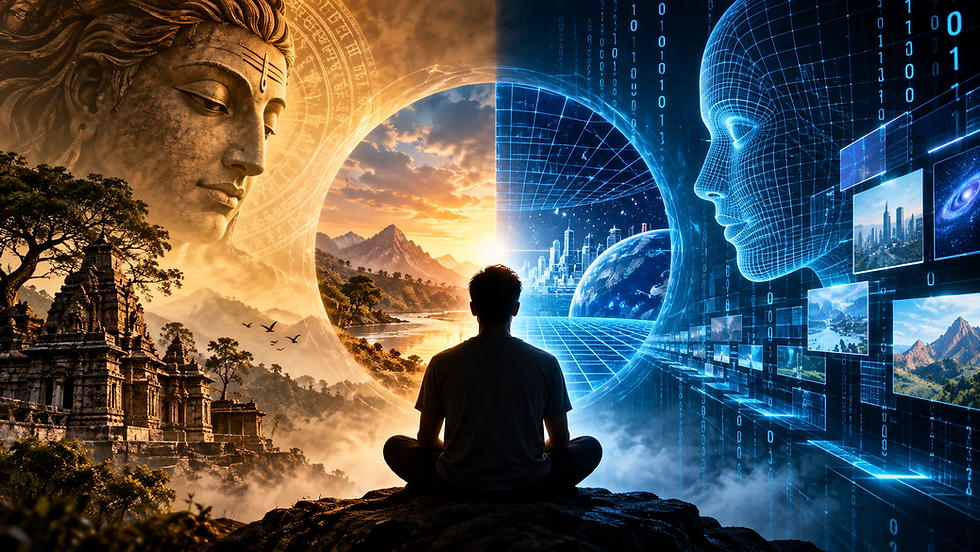
This is also where the discussion connects with modern questions surrounding simulation theory. A simulated reality, if such a thing were ever demonstrated, would still leave the question of the observer unanswered. Knowing that the perceived world is generated by some underlying computational system would not automatically explain why there is an experiencing subject. The question would simply move to another level: who or what is experiencing the simulation?
That is why the philosophical question of consciousness is deeper than the question of whether reality is a simulation. Even if the universe were eventually shown to have an informational or computational structure, the mystery of subjective experience would remain.
Ancient Philosophy and Modern Science Should Not Be Forced Together
There is a growing tendency to search ancient Indian texts for modern scientific discoveries. Sometimes this produces fascinating comparisons, but it can also create serious intellectual problems. The Upanishads should not be treated as disguised physics textbooks, and quantum mechanics should not be used as a convenient explanation for every ancient spiritual concept.
Ancient Indian philosophy deserves better than that.
Its importance does not depend upon proving that the sages possessed modern scientific knowledge. The Upanishadic thinkers were doing something different. They were developing philosophical systems concerned with existence, consciousness, identity, knowledge and ultimate reality. Their methods were different from those of modern experimental science, but their questions remain extraordinarily profound.
Similarly, modern science does not become less meaningful because it cannot yet answer every philosophical question. Science has transformed our understanding of the physical universe precisely because it insists upon evidence, measurement and testable explanations. The fact that consciousness remains difficult to explain should not be used as an excuse to fill the gap with unsupported claims.
The most fruitful approach is therefore not to force agreement but to encourage dialogue. Science can tell us more about the brain. Philosophy can examine what we mean by consciousness. Indian traditions can provide ancient frameworks for thinking about the self. None of these automatically invalidates the others.
What If Ātman Is Not Energy?
Perhaps this is the most important question to ask.
What if Ātman is not energy at all?
What if attempting to classify Ātman as energy already assumes that everything real must fit within the categories of modern physics?
The ancient Indian philosophical position, particularly in its Vedantic forms, may suggest something more radical. Perhaps the deepest self is not another object within the universe. Perhaps it is the subject through which the universe is experienced. If so, trying to measure Ātman as though it were a particle or energy field would misunderstand the nature of the claim.
This is similar to the difference between studying the eye and studying vision as experience. We can examine the physical structure of the eye, the neural pathways involved in visual processing and the brain regions associated with visual perception. But the subjective experience of seeing remains a first-person phenomenon. The philosophical question concerning Ātman operates at a similarly fundamental level: it asks about the subject rather than merely another object.
From this perspective, Ātman is not a hidden form of energy waiting to be discovered by a more powerful instrument. It is a philosophical proposition about the nature of the self and consciousness.
The Deeper Question
Human beings have spent thousands of years trying to understand the universe. We have looked outward toward the stars and inward toward the microscopic structure of matter. We have built telescopes that can observe galaxies billions of light-years away and instruments capable of probing the smallest known physical structures. Yet the most immediate mystery remains inside every conscious being: why am I experiencing anything at all?
The universe may contain billions of galaxies, countless stars and an enormous variety of physical structures, but none of these facts by themselves explain subjective awareness. Somewhere within this universe—or perhaps at a more fundamental level of reality—there exists the phenomenon we call consciousness.
The ancient Indian philosophical traditions took this mystery seriously. They did not merely ask what the universe is made of. They asked who is experiencing the universe. They did not merely examine the objects of perception. They investigated the perceiver. They did not stop at the body. They investigated the relationship between body, mind, consciousness and ultimate reality.
Ātman emerged from this investigation as the concept of the deepest self.
It is therefore perhaps more accurate to describe Ātman not as “ancient Indian energy” but as one of the world's most profound philosophical attempts to understand the nature of consciousness and identity.
Conclusion: Beyond Matter and Energy
The modern world has become extraordinarily sophisticated in its understanding of matter and energy, but consciousness remains one of its deepest unresolved mysteries. We know that consciousness is intimately connected with the brain, yet the precise nature of subjective experience continues to generate profound philosophical and scientific questions. We know how physical systems behave with increasing precision, but we still debate why there is an inner experience associated with some of those systems.
The concept of Ātman offers a radically different starting point. It does not begin by assuming that consciousness is simply a product of matter. Instead, it asks us to investigate the experiencer itself. What is the self beneath the changing body? What remains beneath the changing mind? Is consciousness merely something that the universe produces, or is consciousness somehow fundamental to the nature of reality?
There is currently no scientific evidence establishing that Ātman is a form of physical energy. Nor should the principles of modern physics be presented as proof of ancient Vedantic metaphysics. Such claims go beyond the available evidence. But there is also no need to dismiss the ancient inquiry simply because it does not fit neatly into the vocabulary of contemporary science.
Perhaps the greatest value of Ātman is precisely that it refuses to let the discussion end with matter and energy. It asks us to consider the possibility that reality has another dimension: the dimension of experience itself.
The body changes. The mind changes. Thoughts arise and disappear. Emotions come and go. Memories evolve. Personal identity transforms across the years. Yet throughout these changes there remains the extraordinary fact that experience is happening.
The Upanishadic sages gave the deepest dimension of this inquiry a name: Ātman.
Perhaps the question for the modern world is not whether Ātman can be reduced to energy.
Perhaps the deeper question is whether energy and matter themselves are sufficient to explain the existence of consciousness.
And that question remains open.
Who is the one experiencing the universe?
Perhaps that is the question with which the journey into Ātman truly begins.


Comments