top of page
03:04
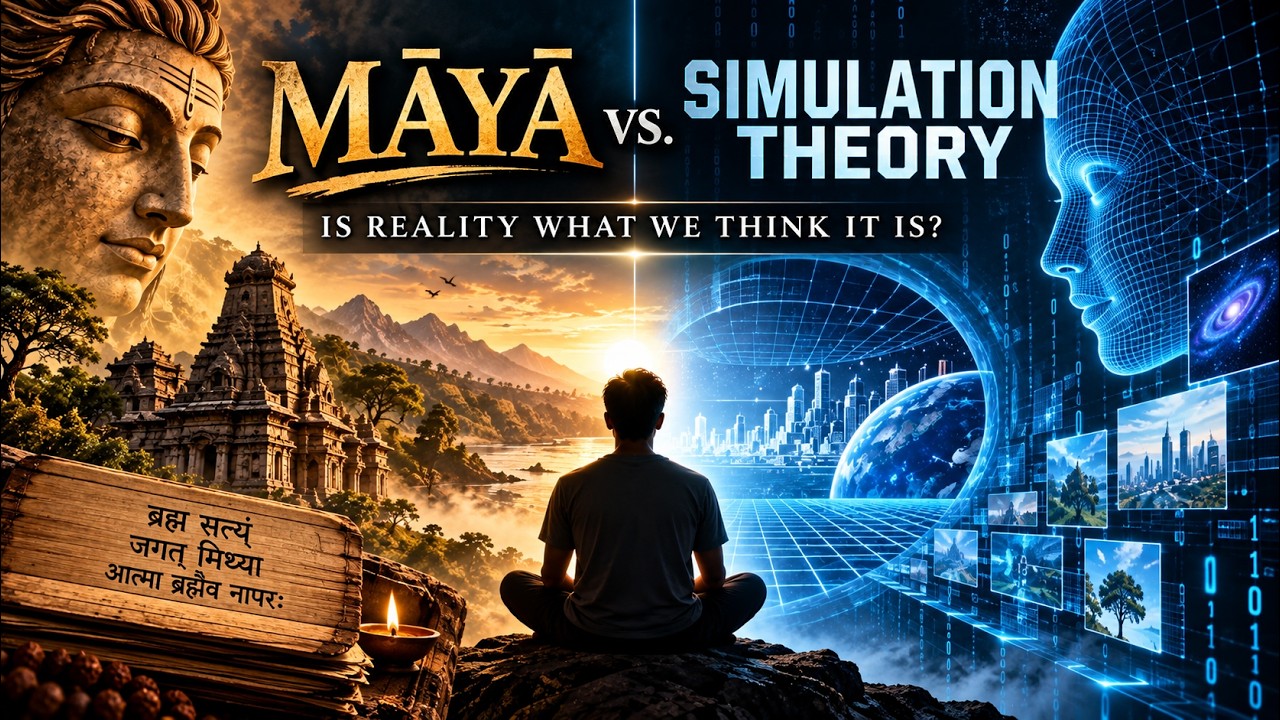
Are We Living in a Simulation? The Ancient Indian Idea of Māyā
What if reality is not quite what it appears to be?
For centuries, Indian philosophical traditions have questioned the relationship between appearance and ultimate reality through concepts such as Māyā, Brahman, Ātman and mithyā. Today, modern philosophers ask a remarkably different but strangely familiar question: could the universe itself be a simulation?
In 2003, philosopher Nick Bostrom proposed his influential Simulation Argument, raising the possibility that advanced civilizations could create vast numbers of simulated conscious observers.
But does this mean ancient Indian philosophy predicted modern Simulation Theory?
Not so fast.
In this episode of Indic Eternum, we explore the fascinating similarities—and fundamental differences—between Māyā and the Simulation Hypothesis.
Is the world an illusion?
Could reality be computational?
What is consciousness?
And perhaps the deepest question of all: who is the observer experiencing reality?
Māyā does not prove Simulation Theory. Simulation Theory does not prove Māyā. But placing them side by side reveals a profound philosophical question that remains unresolved:
Is reality really what we think it is?
Indic Eternum examines ancient Indian thought alongside modern science, philosophy and technology—not to claim that one predicted the other, but to explore where their questions meet and where they fundamentally diverge.
#Maya, #SimulationTheory, #SimulationHypothesis, #AdvaitaVedanta, #IndianPhilosophy, #AncientIndianPhilosophy, #Brahman, #Atman, #Consciousness, #Reality, #Philosophy, #Metaphysics, #ModernScience, #IndicEternum, #IndianWisdom

09:09
India's Sacred Geography: How Rivers, Mountains Built the World's Oldest Living Civilization
Why has India remained one of the world's oldest continuously living civilizations while many ancient civilizations disappeared? The answer lies not only in its philosophies, scriptures, or kingdoms, but also in the unique relationship between its people and the land itself.
In this Indic Eternum episode, we explore the profound concept of Sacred Geography—the idea that mountains, rivers, forests, and pilgrimage routes are not merely physical locations but living expressions of the divine. From the Himalayas to the Ganga, from sacred forests to ancient pilgrimage circuits, discover how India's geography shaped its culture, spirituality, environmental ethics, and civilizational resilience.
Learn how this unique worldview influenced philosophy, governance, architecture, ecology, and social unity for thousands of years, and why it remains relevant in an era of climate change and environmental challenges.
If you enjoy deep explorations of Indian civilization, history, philosophy, and culture, subscribe to Indic Eternum for more insightful content.
#IndicEternum #SacredGeography #IndianCivilization
#SanatanaDharma #AncientIndia #IndianHistory #HinduPhilosophy #SpiritualIndia #CulturalHeritage #IndianCulture
Indic Eternum, Sacred Geography, Indian Civilization, Ancient India, Sanatana Dharma, Indian Culture, Indian History, Hindu Philosophy, Ganga, Himalayas, Pilgrimage, Sacred Rivers, Cultural Heritage, Environmental Ethics, Spiritual India, Indic Knowledge, Bharat, Vedic Civilization, Indian Traditions, Civilizational Studies,

05:43
Why Ancient Indian Temples Were Built Like Mountains
Why were ancient Indian temples designed to resemble towering mountains? Was it merely an architectural choice, or did these magnificent structures embody a profound understanding of the cosmos, spirituality, science, and human consciousness?
In this Indic Eternum episode, we uncover the hidden philosophy behind India's temple architecture. From the concept of Mount Meru and sacred geometry to Vastu Shastra, astronomical alignments, acoustics, and the role of temples as centres of education, culture, and economic life, discover why these timeless monuments continue to inspire people around the world.
Whether you're interested in Indian history, Hindu philosophy, ancient architecture, archaeology, or cultural heritage, this documentary explores the deeper meaning behind one of humanity's greatest architectural traditions.
Subscribe to Indic Eternum for insightful explorations of India's timeless wisdom, civilization, philosophy, history, and cultural heritage.
#IndicEternum #AncientIndia #IndianTemples #TempleArchitecture #SacredGeometry #VastuShastra #MountMeru #IndianHistory #HinduPhilosophy #SanatanaDharma #Civilization #AncientWisdom #CulturalHeritage #Spirituality #HistoryDocumentary

08:43
What Does "Aham Brahmasmi" Really Mean?
What does Aham Brahmasmi really mean?
For thousands of years, this profound declaration from the Brihadaranyaka Upanishad has inspired philosophers, sages, and spiritual seekers across India. Yet today, it is often misunderstood as a statement of ego or personal divinity.
In this episode of Indic Eternum, we explore the true meaning behind one of the four Mahavakyas of the Upanishads. Journey into the heart of Advaita Vedanta as we uncover the relationship between Atman and Brahman, why the ancient sages considered this realization the highest form of knowledge, and how this timeless wisdom remains deeply relevant in an age of identity crises, social media, and constant comparison.
This is not merely a lesson in philosophy. It is an invitation to rediscover one of humanity's oldest and most profound questions:
Who am I?
Join us as we explore the civilizational wisdom of India—one idea at a time.
Read the complete analysis- https://www.indiceternum.com/post/aham-brahmasmi-meaning-upanishads
Subscribe to Indic Eternum for thoughtful explorations into Indian civilization, philosophy, spirituality, history, culture, and timeless wisdom.
#AhamBrahmasmi #Upanishads #Vedanta #AdvaitaVedanta #IndianPhilosophy #HinduPhilosophy #SanatanaDharma #Brahman #Atman #Mahavakya #IndicEternum #IndianCivilization #AncientWisdom #Spirituality #Consciousness #SelfRealization #IndianCulture #Philosophy #History #CivilizationalWisdom
bottom of page