What Is Reality? The Ancient Indian Map of Existence


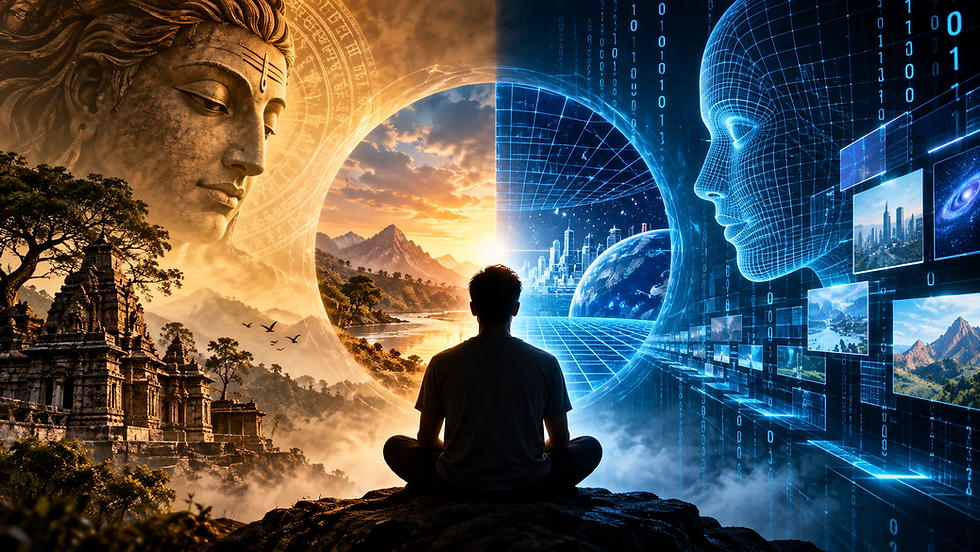
Human beings have always lived inside reality without necessarily knowing what reality is.
We see the world around us, interact with other people, experience pleasure and pain, remember the past, anticipate the future and assume that the physical universe exists independently of us. The ground beneath our feet appears solid. Time seems to move in one direction. Matter appears to be the fundamental substance of existence. Consciousness appears to be something produced by the brain. These assumptions are so deeply embedded in ordinary life that questioning them can seem almost absurd.
Yet the moment we begin asking fundamental questions, the apparent certainty starts to disappear.
What exactly is matter? What is consciousness? Does the universe exist independently of observation? What is the relationship between the observer and the observed? Is time fundamental, or does it emerge from something deeper? Is the physical world the whole of reality, or merely one layer of it? And perhaps the most difficult question of all: why is there something rather than nothing?
Modern physics, cosmology, neuroscience and philosophy continue to wrestle with versions of these questions. But these questions are not new.
Thousands of years ago, Indian philosophical traditions developed extensive systems for investigating existence itself. Their approaches were radically different from modern experimental science, and it would be misleading to claim that ancient Indian philosophers possessed modern physics in symbolic form. They did not. Their methods, assumptions and objectives were different. Yet they were willing to investigate something that modern civilization often takes for granted: the possibility that the reality we experience is not the entirety of reality.
This is where concepts such as Brahman, Ātman, Māyā, Prakṛti, Puruṣa, consciousness, mind, time and cosmic cycles become important.
Taken together—not as one single unified doctrine, because Indian philosophy contains many competing schools—they reveal an intellectual civilization deeply interested in mapping existence.
The question was not merely, “What is the world made of?”
It was something much larger:
“What is the nature of that which we call reality?”
The World We Experience
Our everyday understanding of reality begins with perception.
We see mountains, rivers, animals, people, stars and planets. We touch objects and experience their resistance. We hear sounds, smell substances, taste food and perceive light. From these sensory experiences, the mind constructs an understanding of the external world.
This seems straightforward.
But Indian philosophers noticed a fundamental problem.
Everything we experience through the senses is mediated by consciousness.
We do not encounter the external world in some completely unfiltered manner. Light enters the eyes, sound reaches the ears, signals are transmitted through the nervous system and the mind interprets these experiences. Memory, expectation, emotion and cognition all influence how the world appears to us.
The philosophical question therefore becomes unavoidable:
Are we experiencing reality itself—or reality as it appears to consciousness?
This distinction is central to several Indian philosophical traditions.
It is also one reason the concept of Māyā has been so frequently misunderstood.
Māyā is often casually translated as “illusion,” leading to the impression that Indian philosophy simply claimed that the world does not exist.
That is far too simplistic.
In the philosophical traditions where Māyā becomes central, the issue is not necessarily that the world is equivalent to a hallucination. Rather, the problem concerns the difference between appearance and ultimate reality, between what is experienced and what is ultimately the case.
A rope mistaken for a snake provides the classical type of illustration. The snake is experienced, and the fear generated by that experience can be completely real. Yet the underlying reality is different from the appearance.
The example is powerful because it demonstrates something fundamental:
An experience can be real as an experience without being an accurate description of the underlying reality.
That distinction opens the door to an entirely different way of thinking about existence.
Brahman: Reality Behind Reality
Among the most profound concepts in the Indian philosophical tradition is Brahman.
In the Upanishadic traditions, Brahman is not simply another object existing somewhere within the universe. It is associated with the ultimate ground or reality underlying existence itself.
This immediately creates a conceptual difficulty.
If Brahman is the ultimate reality, it cannot simply be another thing that we can point toward.
A mountain is an object.
A planet is an object.
A galaxy is an object.
Even the entire observable universe, considered as something we can conceptualize, becomes an object of thought.
But if there is an ultimate ground of reality, it cannot simply be another object sitting somewhere inside reality.
This is one reason Brahman is approached through philosophical negation, paradox and indirect description.
The famous Upanishadic expression “neti, neti” — “not this, not this” reflects an approach in which ultimate reality cannot be completely captured by ordinary conceptual categories.
It is not saying that nothing exists.
It is suggesting that our ordinary categories may be inadequate to describe the ultimate nature of existence.
This is an extraordinarily ambitious philosophical proposition.
The universe that we perceive may consist of countless forms and distinctions, but beneath those distinctions there may be a more fundamental reality that cannot itself be reduced to any individual form.
Ātman: The Question Turns Inward
If Brahman concerns the ultimate nature of reality, Ātman introduces an equally radical question:
Who is the one experiencing reality?
The ordinary answer is obvious: “I am.”
But what exactly is this “I”?
Is it the body?
The body changes continuously. Cells die and are replaced. Childhood disappears into adulthood. Physical appearance changes. Yet we maintain a sense of personal continuity.
Is the “I” the mind?
Thoughts change constantly. Emotions appear and disappear. Memories can be altered or lost. Yet we can observe our thoughts and emotions.
If thoughts can be observed, Indian philosophical traditions ask, who is the observer?
This leads to the idea of consciousness as something that cannot simply be equated with the contents of consciousness.
You can observe a thought.
You can observe an emotion.
You can observe a sensation.
You can even observe your own mental activity.
But the philosophical question remains:
What is that which knows the experience?
Different Indian schools answer this question differently. There is no single Indian doctrine of consciousness. But the insistence on examining the distinction between the knower, knowing and known became one of the defining features of Indian philosophical inquiry.
In some traditions, Ātman represents the deepest self, ultimately associated with the ground of reality itself.
In others, this interpretation is rejected.
That disagreement is important.
Indian philosophy was not a single monolithic worldview. It was a vast intellectual ecosystem containing Vedānta, Sāṃkhya, Yoga, Nyāya, Vaiśeṣika, Mīmāṃsā, Buddhism, Jainism and numerous internal schools and debates.
The map of reality was therefore contested.
And that makes it even more interesting.
Māyā: When Appearance Becomes the Problem
The human mind normally assumes that what appears before it is reality.
Indian philosophy repeatedly challenges this assumption.
Māyā, particularly in Advaita Vedānta, becomes a powerful framework for understanding the difference between ultimate reality and empirical experience.
The world of ordinary experience is not simply dismissed. We live in it, act within it and experience its consequences. But it may not represent reality in its ultimate form.
This creates a hierarchy of questions.
At one level, there is the world we experience.
At another, there is the consciousness through which we experience it.
And beyond that, the philosophical inquiry asks whether there is an underlying reality from which both the subject and object of ordinary experience ultimately arise.
This is where the Indian philosophical approach becomes remarkably different from ordinary materialism.
Instead of beginning with matter and asking how consciousness emerges from it, some Indian traditions begin with consciousness or ultimate reality and ask how the experienced universe comes to appear within it.
The direction of inquiry is reversed.
That does not make the ancient position scientifically correct.
But it makes the philosophical question profoundly important.
Prakṛti: The Machinery of Manifestation
Another major concept emerges in Sāṃkhya philosophy: Prakṛti.
Here we encounter a very different philosophical framework from Advaita Vedānta.
Sāṃkhya distinguishes between Puruṣa, associated with consciousness, and Prakṛti, associated with material or phenomenal nature.
Prakṛti is not merely “matter” in the modern scientific sense. It represents the dynamic principle from which the manifest world evolves.
The familiar three guṇas—sattva, rajas and tamas—describe fundamental tendencies within Prakṛti.
From this framework emerges an elaborate account of manifestation involving intellect, ego, mind, senses and the elements.
Whether or not one accepts the metaphysics, what is striking is the ambition of the system.
Reality is not treated as an undifferentiated collection of objects.
It is analysed as a structured process of manifestation.
The universe becomes something that can be philosophically decomposed into different levels of experience and existence.
This is one reason ancient Indian philosophy should not be reduced to mythology.
Much of it was speculative metaphysics—but it was systematic metaphysics.
Reality Is More Than Matter
Modern civilization has largely inherited a materialist intuition: matter is fundamental, and everything else must somehow arise from it.
Consciousness, in this view, is generally approached as something produced by biological processes in the brain.
But consciousness remains one of the deepest unresolved problems in contemporary philosophy and science.
We know enormous amounts about neural activity.
We can measure electrical signals, observe brain structures and correlate neural states with experiences.
Yet the fundamental philosophical question remains:
Why should physical processes be accompanied by subjective experience at all?
Why does seeing red feel like something?
Why does pain have a subjective quality?
Why is there an inner world?
This is sometimes described as the hard problem of consciousness.
Ancient Indian philosophers were approaching the question from a radically different direction.
Instead of asking only how consciousness emerges from physical processes, they often treated consciousness as fundamental to the investigation itself.
After all, every scientific observation is ultimately experienced by a conscious observer.
This creates an intriguing philosophical loop:
Science investigates the universe through consciousness, while consciousness itself remains part of the mystery of the universe.
Indian philosophy spent centuries examining precisely this relationship.
The Universe Was Not Necessarily Static
The Indian conception of reality also extends beyond consciousness and matter.
It extends into time.
Modern popular culture often imagines ancient civilizations as believing in a simple linear progression: creation, history and eventual destruction.
Indian cosmological traditions developed something far more elaborate.
The universe could be understood through enormous cycles of creation, preservation and dissolution.
The concepts of Yugas, Mahāyugas, Manvantaras and Kalpas describe extraordinarily large temporal scales within Purāṇic cosmological traditions.
These numbers should not be casually presented as ancient measurements of the modern scientific age of the universe. The cosmological systems belong to their own philosophical and religious frameworks.
But the underlying intuition is fascinating:
The universe need not be a one-time event.
Existence can be imagined as cyclical.
Creation can be followed by dissolution.
Dissolution can be followed by creation.
The universe becomes less like a machine that begins at a single moment and more like a process that unfolds through immense cycles.
Modern cosmology has explored various cyclic and oscillatory models of the universe, although none should be equated directly with Indian cosmology.
The important point is not that ancient India “predicted modern cosmology.”
It is that Indian thinkers were comfortable contemplating cosmic timescales vastly beyond ordinary human experience.
Time Itself Becomes a Philosophical Problem
The deeper we go, the more difficult time becomes.
We experience time as a sequence:
past → present → future.
But is that structure fundamental to reality?
Indian philosophical traditions developed multiple ways of thinking about time, including enormous cycles and different levels of temporal experience.
The distinction between ordinary human time and cosmic time appears repeatedly in Indian cosmological thinking.
This has an interesting philosophical consequence.
Perhaps the universe cannot be understood simply from the perspective of an individual human lifespan.
A human life may be decades long.
Civilizations may exist for centuries.
Geological processes unfold over millions of years.
Stars live for billions of years.
Cosmological processes operate on scales almost impossible for the human imagination.
The ancient Indian willingness to think in immense temporal cycles was therefore not merely an exercise in large numbers.
It was also a philosophical attempt to decentralize the human perspective.
The universe did not exist for us.
We existed within something vastly larger than ourselves.
The Universe as Layers of Reality
One of the most interesting features of Indian philosophical thought is its tendency to distinguish different levels of existence and experience.
Physical reality is not necessarily the only category.
There is the body.
There are the senses.
There is the mind.
There is intellect.
There is ego.
There is consciousness.
Different traditions arrange and interpret these categories differently, but the recurring theme is unmistakable:
Human experience is layered.
The person is not simply a body.
The mind is not simply the senses.
The observer is not necessarily identical to the objects being observed.
This layered conception also appears in different forms through ideas such as the pañca kośas, or five sheaths, in the Taittirīya Upanishad tradition.
The human being is described through progressively deeper layers, beginning with the physical and moving toward subtler dimensions of experience.
Again, this should not be presented as an ancient anatomical discovery.
It is a philosophical model.
Its significance lies in the fact that ancient Indian thinkers were willing to treat subjective experience itself as something worthy of systematic investigation.
Where Modern Science Enters the Conversation
This is where we need intellectual discipline.
It is tempting to look at these ancient concepts and immediately connect them to quantum physics, relativity, information theory or neuroscience.
Sometimes the parallels are fascinating.
But a parallel is not proof of identity.
Brahman is not quantum field theory.
Māyā is not simulation theory.
Ātman is not automatically equivalent to consciousness as understood by neuroscience.
Prakṛti is not simply matter-energy.
The ancient Indian conception of cosmic cycles is not a direct prediction of modern cosmology.
These distinctions matter.
If we erase them, we turn a sophisticated philosophical tradition into a collection of sensational internet claims.
But if we preserve the distinction, something much more interesting emerges.
Ancient Indian philosophy and modern science can sometimes ask similar fundamental questions while using completely different methods.
Science asks questions through observation, measurement, mathematical modelling and experiment.
Philosophy asks questions through reasoning, conceptual analysis, introspection and argument.
Their methods are different.
But their questions can occasionally converge.
What is matter?
What is consciousness?
What is time?
What is causality?
What is the relationship between observer and observed?
Is reality fundamentally composed of objects, processes, fields, information—or something deeper?
These questions remain open in different ways.
The Great Difference: Knowing Reality Versus Measuring Reality
Perhaps the most important distinction between the ancient Indian approach and modern science is the purpose of inquiry.
Modern science primarily seeks reliable models of observable phenomena.
Indian philosophical traditions often sought something more existential:
How can reality be known directly, and what does such knowledge do to the individual?
This is why Indian philosophical traditions frequently connect metaphysics with liberation.
Knowledge was not merely information.
Understanding reality could transform the person who understands it.
The ultimate philosophical problem therefore becomes inseparable from the human condition.
If I misunderstand reality, I misunderstand myself.
If I misunderstand myself, I misunderstand my relationship with the world.
And if I misunderstand my relationship with the world, I remain trapped within the consequences of that misunderstanding.
The investigation of reality therefore becomes an investigation of existence itself.
The Observer Is Part of the Mystery
There is one final question that brings the entire discussion together.
We normally imagine the universe as something “out there.”
Stars exist.
Galaxies exist.
Planets exist.
Matter exists.
And somewhere inside this enormous universe, a biological organism called a human being appears and begins looking at it.
But there is a strange philosophical circularity here.
The universe produced the observer.
The observer studies the universe.
And the observer is itself part of the universe being studied.
This means that reality has somehow produced beings capable of asking what reality is.
Ancient Indian philosophy took this problem seriously.
Rather than treating consciousness as an irrelevant side effect, many Indian traditions placed the question of the experiencing subject near the centre of philosophical inquiry.
That is perhaps one of the most enduring aspects of the tradition.
The universe is not merely something we observe.
We are part of the mystery we are trying to understand.
An Ancient Map, Not an Ancient Physics Textbook
The temptation in discussions about ancient India and modern science is to search for predictions.
Did the Vedas predict quantum mechanics?
Did the Upanishads discover relativity?
Did ancient Indian philosophers know about atoms?
Did the ancients understand the universe as a simulation?
These questions generate attention, but they can also obscure something much more valuable.
Ancient Indian philosophy does not need to have predicted modern science in order to be intellectually significant.
Its real achievement lies elsewhere.
It developed sophisticated conceptual frameworks for examining existence, consciousness, perception, selfhood, causality, time and the relationship between appearance and reality.
These are not obsolete questions.
They remain some of the deepest questions human beings can ask.
The methods have changed.
The instruments have changed.
The vocabulary has changed.
But the mystery remains.
The Map Is Not the Territory
Perhaps the greatest lesson is that no conceptual system should be mistaken for reality itself.
Brahman is a philosophical concept.
Ātman is a philosophical concept.
Māyā is a philosophical concept.
Prakṛti is a philosophical concept.
Modern physics has its own concepts: quantum fields, spacetime, particles, energy, information and mathematical structures.
None of these concepts should be confused with the reality they attempt to describe.
A map can be extraordinarily sophisticated and still not be the territory.
Ancient India created one of humanity's most ambitious intellectual maps of existence.
It began with the world we experience and repeatedly asked us to look deeper.
Beyond the object was the observer.
Beyond perception was consciousness.
Beyond individual forms was the question of their underlying reality.
Beyond ordinary time was cosmic time.
Beyond the apparent world was the question of what makes appearance possible in the first place.
The resulting philosophies differed enormously from one another.
Some affirmed an ultimate unity.
Some maintained fundamental distinctions.
Some rejected the idea of a permanent self altogether.
Some approached reality through logic and categories.
Others approached it through meditation and direct experience.
There was disagreement.
There was debate.
There was evolution.
And that is precisely what makes the Indian philosophical tradition so compelling.
It was not one answer.
It was a civilization asking what reality means.
The Question Remains
Thousands of years after the earliest Upanishadic inquiries, humanity possesses instruments capable of seeing farther into space and deeper into matter than any ancient philosopher could have imagined.
We can detect gravitational waves.
We can image distant galaxies.
We can manipulate individual particles.
We can map neural activity.
We can construct artificial intelligence.
Yet the fundamental mystery has not disappeared.
We still do not possess a universally accepted answer to the deepest question:
What is reality?
Is it matter?
Energy?
Information?
Consciousness?
A mathematical structure?
A process?
Something that our current conceptual vocabulary cannot adequately describe?
Ancient Indian philosophy does not provide modern science with a ready-made answer.
What it provides is something perhaps more valuable: a reminder that the question itself is ancient, difficult and worth asking at the deepest possible level.
The map drawn by Indian philosophers was created in a world without particle accelerators, space telescopes or computers.
Yet its central challenge remains remarkably contemporary:
Do not confuse what appears with what ultimately is.
Perhaps that is where the ancient Indian inquiry into reality still has something to say to the modern world.
Not because it secretly contained modern physics.
Not because every Sanskrit verse is a coded scientific equation.
But because long before humanity could measure the universe with machines, it had already begun asking the most difficult question of all:
What, ultimately, is the reality in which we exist?


Comments